
What Should Parents Do If an IEP Is Denied? | Parent Guide
The School Denied My Child’s IEP—What Should I Do Next?
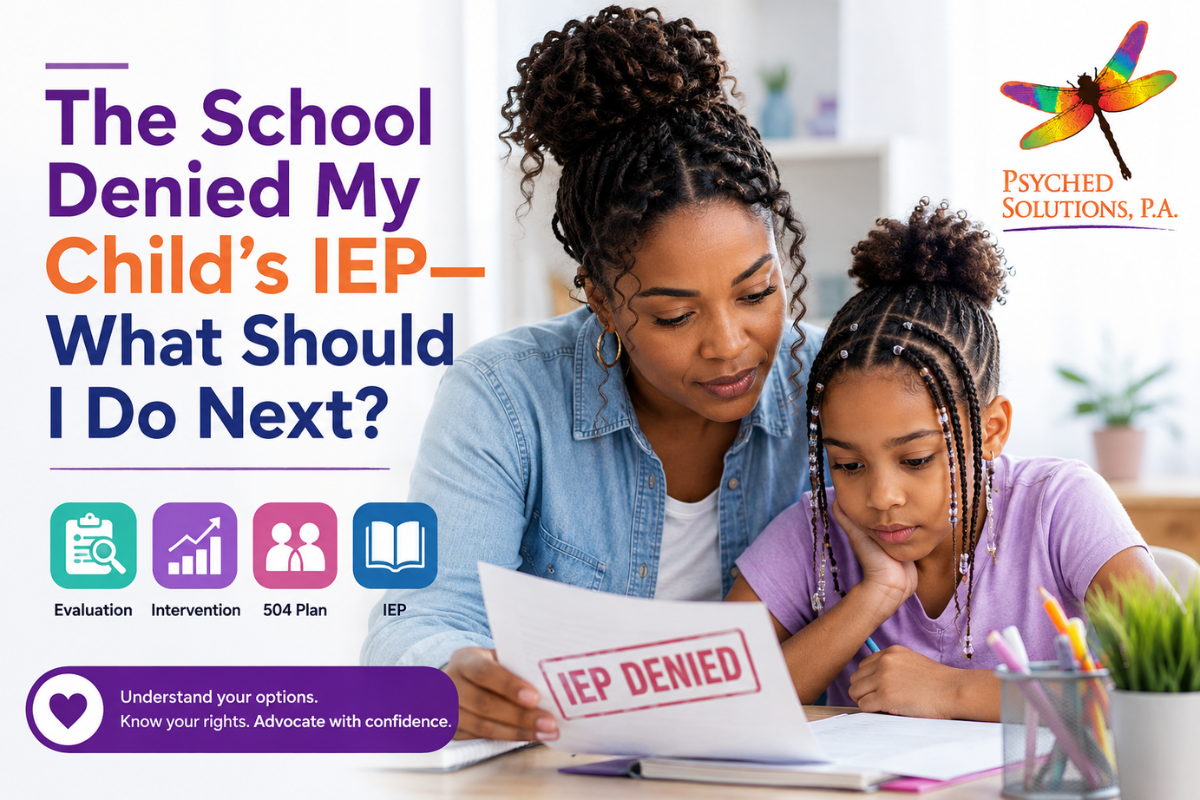
Understanding the difference between an evaluation, intervention, 504 Plan, and IEP—and how parents can advocate effectively for the support their child needs.
It is a situation many parents know all too well: You have watched your child struggle with reading, organization, attention, emotional regulation, or overwhelming after-school meltdowns. You finally reach out to the school for support, only to hear:
“Your child is getting average grades, so they don't qualify for an IEP.”
For parents, this can feel like a door has been closed.
But an IEP denial does not necessarily mean that your child has no educational needs or that there are no other options available. It means the school team has made a determination based on the information available to it—and parents have the right to ask questions, request documentation, provide additional information, and explore other appropriate supports.
As a school psychologist, I encourage families to move the conversation away from “Does my child look like they are struggling?” and toward a more important question:
“What does the data tell us about how my child's disability affects their ability to access and participate in education?”
First, Understand the Difference Between an Evaluation, Intervention, 504 Plan, and IEP
School meetings can be filled with unfamiliar terminology. Understanding these terms can help parents participate more confidently in the process.
1. Evaluation: Understanding Why Your Child Is Struggling
A psychoeducational evaluation is a comprehensive assessment designed to understand a child's cognitive, academic, behavioral, emotional, and/or developmental functioning.
Depending on the referral concerns, an evaluation may examine areas such as:
Cognitive functioning
Academic achievement
Attention and executive functioning
Memory and processing
Emotional and behavioral functioning
Social skills
Adaptive functioning
Learning difficulties
Autism-related characteristics
ADHD-related symptoms
The purpose is not simply to assign a diagnosis. A quality evaluation should help answer a more important question:
What is preventing this child from functioning successfully, and what support do they need?
For example, a child may have average overall grades while still experiencing significant difficulties with executive functioning, reading fluency, written expression, attention, anxiety, or emotional regulation.
Looking only at grades can sometimes miss the larger picture.
2. Intervention: Providing Targeted Support
An intervention is a structured strategy designed to address a specific area of difficulty.
Examples may include:
Reading intervention
Mathematics intervention
Writing support
Organizational-skills training
Executive-function strategies
Behavioral interventions
Self-regulation strategies
Social-emotional interventions
Interventions are intended to address identified needs and provide students with opportunities to develop skills.
Importantly, parents should ask:
What intervention is being provided?
How frequently is it provided?
How is progress being measured?
What does the data show?
A general statement such as “We are monitoring the student” provides much less information than documented intervention and progress-monitoring data.
3. What Is a Section 504 Plan?
A Section 504 Plan is based on Section 504 of the Rehabilitation Act, a federal civil-rights law that protects qualified individuals with disabilities from discrimination.
A 504 Plan generally focuses on providing appropriate accommodations so that a student with a disability has meaningful access to education.
Depending on the student's documented needs, accommodations might include:
Extended time
Preferential seating
Reduced-distraction testing environments
Organizational supports
Written and visual directions
Breaks
Assistive technology
Copies of notes or instructional materials
Additional time for transitions
Other individualized classroom accommodations
A 504 Plan is different from an IEP.
The key question is often whether the student needs accommodations to access education or requires specially designed instruction and related services because of a disability.
4. What Is an IEP?
An Individualized Education Program (IEP) is developed under the federal Individuals with Disabilities Education Act (IDEA).
An IEP is designed for eligible students who have a qualifying disability and, because of that disability, require special education and related services.
An IEP may include:
Present levels of academic and functional performance
Individualized annual goals
Specially designed instruction
Accommodations and modifications when appropriate
Related services
Supplementary aids and services
Progress-monitoring requirements
Participation and placement considerations
The important distinction is this:
An IEP is not simply a list of accommodations.
It provides an individualized educational program designed around the student's identified educational needs.
Why Might a School Say That a Child Does Not Qualify for an IEP?
There can be several reasons.
One common misunderstanding is the belief that good grades automatically mean a child cannot qualify for special education services.
That is not necessarily the case.
A child may be intelligent, motivated, or academically capable while still experiencing significant disability-related difficulties.
For example, a student may spend hours every evening completing homework that classmates finish in 30 minutes. Another child may maintain average grades but experience severe anxiety, exhaustion, organizational difficulties, or emotional dysregulation.
This is why parents should look beyond report cards.
Consider the whole picture:
How much effort does the child need to complete assignments?
How independently can the child work?
Does the child require significant adult assistance?
Are assignments consistently incomplete?
Is the child experiencing frequent emotional distress?
Does the child struggle with attention or executive functioning?
Are there significant differences between cognitive abilities and academic performance?
Are behavioral or emotional symptoms interfering with learning?
Does the child require supports that go beyond what is typically provided in general education?
Educational performance is broader than grades alone.
What Should Parents Do If an IEP Is Denied?
If you believe your child's needs have not been adequately addressed, there are several practical steps you can take.
Step 1: Ask for the Decision in Writing
If the school determines that your child is not eligible for an IEP, ask for the school's written explanation and the information used to make the decision.
You want to understand:
What evaluations were conducted?
What areas were assessed?
What did the testing show?
What concerns did the school identify?
Why did the team determine that the student was or was not eligible?
What supports are currently being provided?
What happens next?
Having this information in writing makes it easier to identify gaps or areas that need further discussion.
Step 2: Bring Additional Information to the Team
Parents can provide relevant outside information, including:
Independent psychological evaluations
Psychoeducational evaluations
Medical documentation
Therapy records, when appropriate
Teacher reports
Previous school records
Behavioral observations
Academic work samples
Progress-monitoring information
An outside evaluation does not automatically guarantee IEP eligibility, but it can provide the school team with additional information to consider.
A comprehensive evaluation should connect test findings to the child's actual functioning—not simply provide a list of scores.
Step 3: Consider Whether a 504 Plan May Be Appropriate
If the school determines that your child does not require specially designed instruction but the child has a disability that substantially limits one or more major life activities, a Section 504 evaluation or plan may be worth discussing.
The appropriate accommodations should be individualized.
Instead of simply checking boxes such as “preferential seating” or “extended time,” ask:
What specific problem is this accommodation designed to address?
For example:
Difficulty initiating multi-step assignments → written task breakdown and organizational support.
The goal should be meaningful support—not simply a generic accommodation list.
Step 4: Ask About Interventions and Progress Monitoring
If the school believes your child can remain in general education with interventions, ask for specifics.
You can ask:
“What intervention will be provided?”
“How often will it occur?”
“Who will provide it?”
“How will progress be measured?”
“When will the team review the data?”
This turns a vague promise to “provide additional support” into an actionable plan.
Step 5: Get Help Understanding Your Educational Rights
Special education law can be complicated, particularly when parents are unfamiliar with terms such as eligibility, evaluation, prior written notice, procedural safeguards, accommodations, and specially designed instruction.
Florida families can seek assistance from parent-support and advocacy organizations that provide information about special education rights and the educational process.
If disagreements continue, parents may also wish to seek advice from an appropriately qualified educational advocate or attorney familiar with special education law.
Don't Assume That an IEP Denial Means “Nothing Is Wrong”
Perhaps the most important message for parents is this:
A child does not have to be failing every class for their struggles to deserve attention.
Some children compensate extremely well.
They may be bright enough to compensate for a learning difficulty. They may work twice as hard as their classmates. They may receive extensive support from parents at home. They may become anxious or perfectionistic because they are trying desperately to keep up.
Eventually, the cost of that compensation can become visible through:
Anxiety
School avoidance
Emotional meltdowns
Sleep difficulties
Low self-esteem
Homework battles
Exhaustion
Declining motivation
Social difficulties
Increased family stress
These signs deserve attention.
From Conflict to Collaboration
Parents and schools ultimately share the same goal: helping the child succeed.
Instead of approaching a school meeting as a battle, try approaching it as a data-driven problem-solving conversation.
Bring specific observations.
Ask specific questions.
Request documentation.
Listen to the school's concerns.
Share outside information when appropriate.
And most importantly, keep the conversation focused on the child's individual needs and educational functioning.
The goal isn't simply to obtain an IEP.
The goal is to make sure your child receives the appropriate evaluation, intervention, accommodations, specialized instruction, and support needed to access education and reach their potential.
Is Your Child Struggling Despite “Doing Fine” at School?
If your child is experiencing persistent difficulties with attention, learning, executive functioning, anxiety, emotional regulation, autism-related concerns, or academic performance, a comprehensive psychological or psychoeducational evaluation may help clarify what is happening.
At PsychEd Solutions, P.A., professional evaluations can help families better understand their child's strengths, challenges, and educational needs and provide information that can support conversations with schools.
📞 Call (954) 257-7473 to learn more or schedule an evaluation or educational advocacy consultation.
Dr. Angela C. Brinson, Ph.D. is a Licensed School Psychologist and Holistic Wellness Consultant based in Miami, Florida, with experience working with children, adolescents, ADHD, Autism, twice-exceptional learners, and educational concerns.
Important Disclaimer
This article is provided for general educational and informational purposes only. It is not legal advice, medical advice, psychological advice, or a substitute for an individualized evaluation or consultation.
