The Empty Tank: Why Today's Teens Feel Numb, Unmotivated, and Emotionally Exhausted
The Empty Tank: Why Today’s Teens Feel Numb, Unmotivated, and Emotionally Exhausted
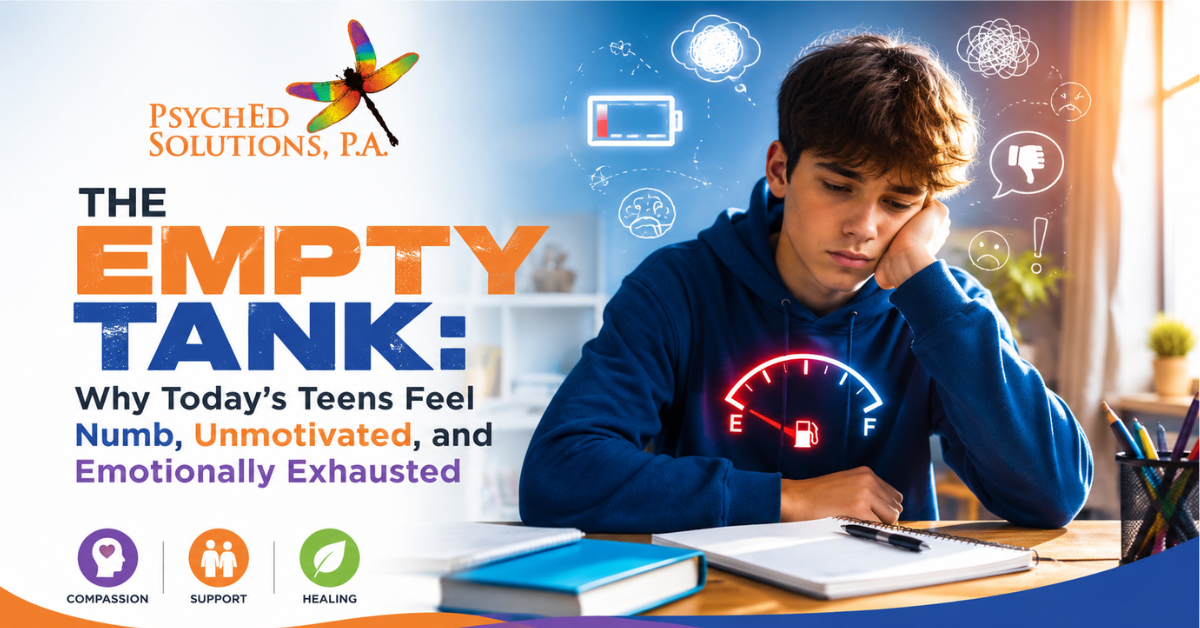
As a Licensed School Psychologist and Holistic Wellness Consultant with more than 25 years of experience, I have seen a growing pattern among today’s adolescents. Many high-achieving teens appear to be doing well academically, participating in extracurricular activities, and meeting expectations. Yet beneath the surface, they feel emotionally drained, disconnected, and unable to find motivation.
If your teenager seems to have lost their spark or treats even simple tasks as overwhelming, it is important to understand that this is rarely a matter of laziness or lack of willpower. More often, it is a sign that their emotional and mental capacity has been exhausted.
The Hidden Cost of Constant Performance
Many teenagers—especially those with ADHD, autism, anxiety, or other neurodevelopmental differences—spend much of their day "masking." Masking is the effort of suppressing natural behaviors, managing sensory overload, and constantly monitoring social interactions in order to fit into environments that may not meet their needs.
For these students, the school day is far more than attending classes. It is a continuous mental and emotional performance that requires significant energy. By the time they arrive home, their emotional reserves are depleted. Homework, chores, and family conversations may feel impossible—not because they do not care, but because they have nothing left to give.
When Success Comes at the Expense of Well-Being
Our culture often celebrates achievement while overlooking the personal cost of maintaining it. Excellent grades, athletic accomplishments, leadership roles, and packed schedules may appear to reflect resilience, but they can also mask chronic stress and burnout.
When nearly all of a teen's energy is devoted to meeting external expectations, there is little capacity left for restorative activities such as quality sleep, physical activity, hobbies, meaningful relationships, or simply relaxing. Over time, this creates a disconnect between external success and internal well-being, leaving many young people emotionally exhausted despite their accomplishments.
Understanding the Biology Behind Emotional Exhaustion
Emotional depletion is not simply psychological—it has a biological foundation.
Healthy sleep is essential for brain development, emotional regulation, memory consolidation, and stress recovery. Chronic sleep deprivation and prolonged stress increase activity in the brain's emotional centers while reducing the effectiveness of the prefrontal cortex, the region responsible for planning, motivation, decision-making, and emotional control.
When this imbalance continues over time, many teens experience emotional numbness, reduced motivation, irritability, difficulty concentrating, and a persistent feeling of being overwhelmed. In many cases, the brain is attempting to protect itself by conserving energy after prolonged stress.
The Impact of the Digital World
Today's adolescents also face constant digital stimulation. Social media platforms and endless scrolling are intentionally designed to capture attention and provide continuous rewards, making it difficult for developing brains to disengage.
For teens with ADHD, these platforms can intensify impulsivity and create an ongoing search for stimulation. At the same time, social media often fosters comparison, fear of judgment, and pressure to present a perfect image. Feeling constantly observed or evaluated increases emotional fatigue and reinforces the need to hide authentic thoughts and feelings.
Moving Beyond Rewards and Punishments
When a teenager is emotionally depleted, traditional approaches such as rewards, consequences, or repeated reminders are often ineffective because they do not address the underlying issue.
Instead, the focus should be on rebuilding capacity. This includes healthy routines, restorative sleep, balanced nutrition, emotional support, and creating environments where teens feel safe enough to be themselves.
A comprehensive psychological evaluation can often provide the clarity families need. It helps distinguish temporary stress from underlying conditions such as ADHD, anxiety, autism, learning differences, or executive functioning challenges, allowing interventions to be tailored to the individual child.
Helping Teens Refill Their Emotional Tank
Knowledge provides hope. When families understand the reasons behind a teenager's emotional exhaustion, they can replace frustration with compassion and implement strategies that support long-term well-being.
By strengthening the foundations of mental health—including restorative sleep, balanced nutrition, healthy routines, meaningful relationships, and appropriate professional support—we give young people the opportunity not just to succeed, but to thrive.
If your teenager seems emotionally exhausted, unmotivated, or overwhelmed, you do not have to navigate these challenges alone.
📞 Call (954) 257-7473
📩 Contact us today to schedule a comprehensive psychological evaluation or a holistic wellness consultation.
Dr. Angela C. Brinson, Ph.D. is a Licensed School Psychologist and Holistic Wellness Consultant serving families throughout Florida. She specializes in comprehensive evaluations for ADHD, Autism Spectrum Disorder, learning differences, executive functioning challenges, and the emotional well-being of children and adolescents, helping families gain clarity, understanding, and practical solutions.
