
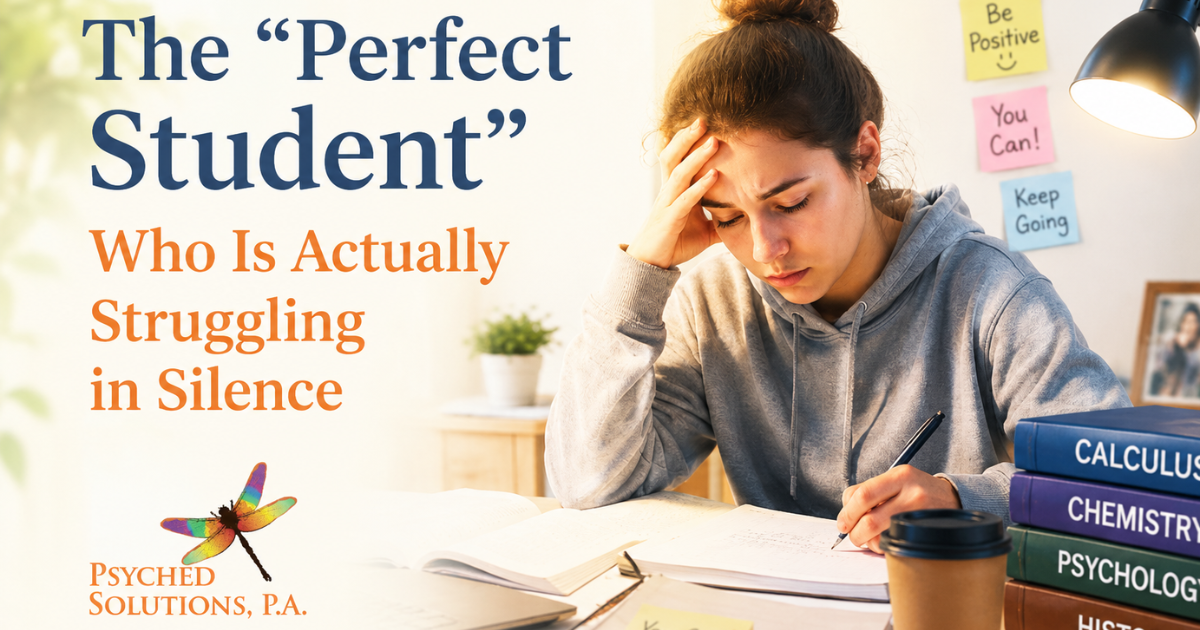
The “Perfect Student” Who Is Actually Struggling in Silence
The “Perfect Student” Who Is Actually Struggling in Silence
By Dr. Angela C. Brinson, Ph.D., Licensed School Psychologist
In my 25 years as a Licensed School Psychologist, some of the most heartbreaking cases I have encountered are the students who appear, on paper, to be thriving.
They earn straight A's, maintain perfect attendance, and receive glowing feedback from teachers. They are often described as "model students" or "the dream child" in the classroom. Yet beneath that polished exterior, many of these children are struggling quietly, expending extraordinary effort simply to make it through each day.
For parents, this can be confusing. How can a child who is succeeding academically seem increasingly anxious, emotionally overwhelmed, or exhausted at home? The answer often lies in understanding the hidden cost of masking and the reality of high-functioning struggle.
The Hidden Exhaustion of Masking
For many neurodivergent students—particularly those with ADHD, Autism Spectrum Disorder, or other differences in learning and processing—the school day involves much more than academics.
Every interaction, transition, and expectation may require conscious effort. These students often work tirelessly to manage distractions, interpret social cues, regulate emotions, suppress natural impulses, and meet the expectations of a neurotypical environment. This process, commonly known as masking, can become an exhausting daily performance.
To teachers and peers, the child may appear attentive, compliant, and highly capable. Internally, however, their executive functioning system may be working overtime to organize tasks, maintain focus, and manage sensory input.
By the end of the school day, many of these students have depleted their emotional and cognitive reserves. While their grades may reflect success, the effort required to achieve that success can leave little energy available for rest, relationships, hobbies, or emotional well-being.
The “Angel at School, Storm at Home” Phenomenon
One of the most common concerns parents share is that their child behaves beautifully at school but becomes emotionally reactive, withdrawn, or defiant at home.
This apparent contradiction often has a simple explanation: home is where the child finally feels safe enough to stop performing.
After spending the day regulating behavior, suppressing stress, and meeting expectations, many children reach a point of cognitive and emotional exhaustion. Once they enter their safe environment, the effort required to maintain the mask is no longer sustainable.
The resulting meltdowns, irritability, shutdowns, or emotional outbursts are frequently misunderstood as laziness, disrespect, or poor discipline. In reality, they may reflect an overwhelmed nervous system that has simply run out of capacity.
Understanding this distinction can help parents respond with compassion rather than frustration.
When Giftedness Hides a Struggle
Many high-achieving students fall into what psychologists refer to as the Twice-Exceptional (2e) category. These students possess significant intellectual strengths while also experiencing challenges such as ADHD, learning differences, anxiety, or Autism.
Their intelligence often allows them to compensate for difficulties during the early school years. As academic demands increase, however, those compensatory strategies may no longer be enough.
Parents are often puzzled when a child who can discuss complex scientific concepts, solve advanced mathematical problems, or demonstrate exceptional creativity struggles with seemingly simple tasks such as:
Turning in completed assignments
Following multi-step directions
Managing time effectively
Keeping track of materials
Remembering daily responsibilities
This is because intelligence and executive functioning are not the same thing.
A gifted student may have extraordinary reasoning abilities while simultaneously struggling with organization, planning, task initiation, and self-monitoring. When attention is focused solely on academic achievement, these underlying challenges can remain hidden for years.
The Critical Role of Sleep and Emotional Resilience
Academic accommodations and emotional support are important, but they cannot replace the biological foundations of well-being.
Quality sleep plays a vital role in emotional regulation, attention, memory consolidation, and stress recovery. During sleep, the brain processes information, restores cognitive resources, and helps regulate stress hormones.
When students are chronically stressed by the demands of masking, perfectionism, or constant performance pressure, restorative sleep often suffers. Over time, this can create a cycle of emotional vulnerability, reduced resilience, and increased sensitivity to everyday challenges.
A child who appears highly successful may actually be operating with a chronically depleted emotional reserve.
Supporting healthy sleep habits, balanced schedules, and opportunities for genuine recovery is often just as important as supporting academic achievement.
Moving from Mystery to Understanding
When a child is struggling beneath a mask of success, parents often feel confused, concerned, and unsure where to turn.
A comprehensive psychological evaluation can provide valuable clarity. Rather than asking, "What is wrong with my child?" the process helps answer a far more meaningful question:
"How is my child uniquely wired, and what support will help them thrive?"
Understanding a child's cognitive profile, executive functioning skills, emotional needs, and learning style allows families and educators to create supports that honor both strengths and challenges.
The goal is not simply academic performance. The goal is helping children build a life in which they can succeed without sacrificing their well-being.
Final Thoughts
Not every struggling child looks like they are struggling.
Sometimes the students who appear the most successful are carrying the heaviest invisible burdens. By looking beyond grades, attendance records, and teacher comments, we can gain a deeper understanding of what our children are truly experiencing.
When we stop demanding perfection and begin supporting individual wiring, we create opportunities for children to move beyond survival mode and toward authentic growth, resilience, and fulfillment.
Is Your Child Struggling Behind a Mask of Success?
If your child appears successful on the outside but is experiencing emotional, behavioral, social, or academic challenges beneath the surface, a comprehensive evaluation may provide the answers you've been seeking.
Dr. Angela C. Brinson, Ph.D.
Licensed School Psychologist & Holistic Wellness Consultant
📞 (954) 257-7473
📩 Contact us to schedule a professional evaluation or holistic wellness consultation.
Specializing in giftedness, ADHD, executive functioning, and the emotional well-being of children, adolescents, and families throughout Florida.
