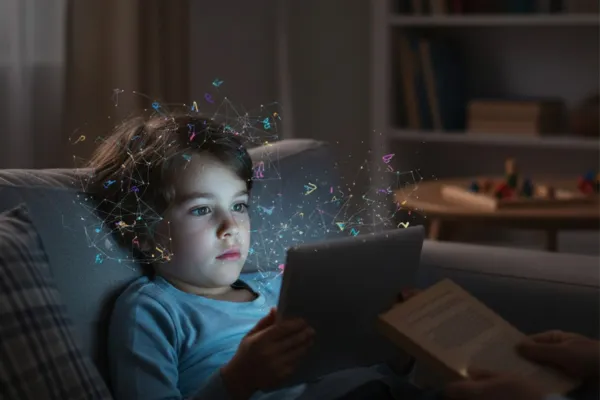
how-screen-time-affects-your-childs-brain
How Screen Time Really Affects Your Child’s Brain (And What To Do About It)
I. The Great Digital Tug-of-War: Is Screen Time Friend or Foe?
Screens are everywhere – practically glued to our hands and eyes! From toddlers swiping at tablets to teens lost in TikTok dances, digital devices are an inescapable part of life. We've moved from the black-and-white glow of the "boob tube" to a dazzling, pocket-sized universe of endless content.
As parents, we're left wondering: Is all this screen time actually rewiring our kids' brains? Are we inadvertently shaping a generation with shorter attention spans and a diminished capacity for real-world connection? And if so, is it all for better or for worse?
It’s not a simple yes or no answer, is it? The science, as ever, reveals a complex, nuanced picture – a tapestry woven with both dazzling benefits and sneaky drawbacks. One might even call it a great digital tug-of-war, where the prize is the very architecture of our children's minds.
In this post, we’re diving deep into the swirling currents of this debate, exploring the science, tracing the history of screens in our homes, dissecting the current arguments, and, most importantly, equipping you with practical strategies to navigate the digital age and safeguard your child's developing mind.
II. A Trip Down Memory Lane: How Screens Invaded Our Homes (And Our Kids' Lives)
Let's take a little trip in the time machine, shall we?
The "Boob Tube" Era (Mid-20th Century): Remember when TV was a rare treat, a special occasion? Families gathered – perhaps a bit too eagerly – around bulky black-and-white sets for shows like "Captain Kangaroo". Even then, whispers of concern began to circulate. Parents worried about kids being "glued to the tube", about the passive consumption of flickering images. These concerns weren't unfounded; by the 1950s, the average child was already clocking in around 4.5 hours of daily viewing.
The Rise of Home Computers (70s-80s): From passive watching to tentative interaction. The digital world began to creep into our homes, not as a mere entertainer, but as a potential tool. Early computer games, with their blocky graphics, and rudimentary word processors began to appear, but screen time was still mostly a desktop affair, a conscious choice rather than a constant companion.
The Internet & Mobile Revolution (90s-Today): Ah, the point of no return. The World Wide Web changed everything. Information flowed freely (or so we thought), and the possibilities seemed endless. Laptops offered portability, but then came the game-changers: smartphones (around 2007) and tablets. Suddenly, screens were portable, personal, and everywhere. The implications were staggering.
Kids started interacting with screens at younger ages than ever – some before 6 months old! Then, the pandemic hit, turbo-charging this trend. Lockdowns and school closures forced entire lives online, and screen time increased by an average of 50%, with many kids hitting 6+ hours a day.
Today, 8-18 year olds are clocking in around 7.5 hours daily (and more if they're multitasking!). The shift to streaming, short videos (TikTok, YouTube Shorts), and immersive gaming is massive, transforming not just how kids spend their time, but what they expect from the world.
Throughout all these tech leaps, the worry about children's development has remained a consistent, nagging theme. We've simply swapped one set of concerns for another, haven't we?
III. The Brain on Screens: What Science Says (The Good, The Bad, and The Thinning Cortex)
Why is all this such a big deal anyway? Because your child’s brain is a super-sponge during childhood, a period of rapid growth and development. It's a time when connections are being forged at an astonishing rate, making it highly sensitive to every experience, every input – including those glowing rectangles.
Let's start with the not-so-great news, the "Uh Oh" moments that make you want to hide all the devices in a locked vault:
Brain Structure & Function: This is where things get a little scary. Excessive screen time has been linked to physical changes in kids' brains! Studies, like the NIH's groundbreaking ABCD study, are showing a premature thinning of the brain's cortex – the critical thinking hub – in children who spend 7+ hours a day glued to screens. Think about that for a moment. The very structure of the brain, altered by digital input. Other research points to under-development in areas crucial for language, reading, empathy, and complex memory. Furthermore, too much stimulation can over-activate the dopamine reward system, potentially making natural rewards – like social interaction, outdoor play, or even a good book – seem less exciting, less rewarding.
Cognitive Headaches: Beyond structural changes, we see functional consequences. Kids get accustomed to the hyper-stimulating, fast-paced content that dominates so many screens, making it difficult to focus in less exciting (ahem, school) environments. We see delayed language development, problem-solving difficulties, and memory issues. Children struggle to transfer knowledge learned on a screen to real-life situations. Executive functions – those crucial skills related to planning, self-regulation, and impulse control – can also take a hit.
Social & Emotional Rollercoasters: This is perhaps the most subtle, yet insidious effect. Excessive screen time can lead to difficulty interpreting emotions and picking up on nonverbal cues. It's linked to an increased risk of anxiety, depression, aggression, and irritability, especially in older children. And let's not forget the sleep sabotage! Blue light from screens before bed is a notorious melatonin suppressor, messing with sleep cycles and leading to tired, cranky kids (and equally tired, cranky parents).
And, of course, there's the physical fallout: less movement, more snacking, a higher risk of childhood obesity.
But wait! Before you toss all the devices into the nearest body of water, let's consider the "Phew!" moments, the glimmers of hope in this digital landscape:
Smart Screen Time: When used strategically, educational apps, games, and programs can actually boost early reading skills, critical thinking, strategic thinking, and creative problem-solving. It's all about how and what.
Connectivity & Socialization: Let's not dismiss the power of connection. Video chats help maintain long-distance family ties. Multiplayer games can foster teamwork, communication, and friendships, especially for kids facing social barriers.
Creativity & Motor Skills: Digital art, music composition, and interactive apps can spark creativity and even improve hand-eye coordination. The key, as always, is balance and mindful engagement.
IV. The Great Debate: Why We Can't Just Agree on "How Much?"
If only it were as simple as saying "No more than X hours a day!" Alas, the debate surrounding screen time is far more complex.
"It's Complicated" - The Critics Speak: Many experts argue that "screen time" is too broad a term, too blunt an instrument. Is passively watching television really the same as engaging with an educational app? Of course not! There are also concerns that much of the research is flawed, inconsistent, relies on self-reported (often inaccurate) data, and fails to account for other crucial factors, such as a child's pre-existing mental health or social environment. Some scientists even argue that the fears surrounding screen time are "overstated" and that we lack robust evidence for specific "cut-off" times.
And then there's the age-old question: Is it causation or correlation? Could existing behavioral or mental health challenges actually lead to more screen time, rather than screens causing the issues?
Conflicting Guidelines: Even major health organizations (WHO, AAP, NHS) offer slightly different recommendations, leaving parents scratching their heads in confusion. Critics also point out that guidelines sometimes overlook the real benefits screens can offer, especially for children in underserved communities who may lack access to other resources.
The 3 C's Framework: Increasingly, experts are moving towards a more nuanced approach, one that focuses on the Content (what they watch), the Context (how and where they watch), and the individual Child (their age, temperament, and developmental stage). It's about understanding the whole picture, not just counting minutes.
V. The Rulebook: What the Experts (Mostly) Agree On (and What YOU Can Do)
Despite the ongoing debates, a general consensus is emerging: less is definitely more for the youngest brains, and for all ages, quality and balance are paramount.
Age-by-Age Guide (The Simplified Version):
Babies (Under 18 months): NO SCREENS, except for occasional video calls with family (always with a caregiver present!). Real-world interaction is absolutely paramount at this stage.
Toddlers (18-24 months): Very limited, HIGH-QUALITY educational content, co-viewed with you. Avoid solo screen time like the plague.
Preschoolers (2-5 years): Max 1 hour/day of high-quality educational programming, co-viewed with you. Think "Sesame Street," not endless, mindless cartoons.
School-Aged Kids (6+ years): No rigid "time limit" but focus on balance. Recreational screen time should be limited (e.g., aiming for less than 2-3 hours/day, excluding homework). Prioritize sleep, physical activity, and face-to-face social interaction.
Your Action Plan: Practical Tips for Screen Savvy Parents:
Be the Boss of the Device: Set clear daily/weekly time limits. Use parental controls – they're your friend!
Create Screen-Free Zones & Times: No screens at dinner, in bedrooms, or for at least 30-60 minutes before bedtime. Charge devices outside bedrooms!
Content is King (or Queen!): Choose educational, interactive, and pro-social apps/shows. Discuss what they're seeing and help them distinguish between "brain food" and "junk food" content.
Co-Pilot with Your Kid: Watch, play, and interact with them. This helps them understand and apply lessons to the real world, and also gives you valuable insight into their digital world.
Offer Awesome Alternatives: Actively encourage outdoor play ("green time"), reading physical books, creative hobbies (art, music), board games, and face-to-face socializing. Unstructured play is golden!
Model Good Behavior: Put your own phone down when with your kids. They learn by example, often more powerfully than by instruction.
No Screens as Pacifiers: Avoid using devices to stop tantrums or as a primary babysitter – it elevates the perceived importance of screens in their young minds.
Craft a Family Media Plan: The AAP's HealthyChildren.org offers great resources to help you build a personalized plan that works for your unique family dynamics.
VI. Looking Ahead: The Digital Frontier (and Our Kids' Brains)
The digital landscape is ever-shifting. New technologies like AI, smart glasses, and virtual communities are constantly emerging, making the future of screen time even more complex, and potentially more immersive.
The science, as always, is playing catch-up. We need more nuanced, longitudinal studies to fully understand the long-term impacts of these new technologies on our children's developing brains.
But there is hope. By staying informed, being proactive, and prioritizing a balanced approach, we can harness the benefits of technology while shielding our children from its potential downsides. It’s about teaching digital literacy and resilience, equipping them to navigate a future we can only begin to imagine.
VII. Conclusion: Empowering Your Child in a Screen-Filled World
The impact of screen time on your child's brain is real and multifaceted. It's a challenge, yes, but it's not an insurmountable one.
As parents, you hold significant influence in shaping your child's digital world. You are the gatekeepers, the guides, the role models.
With mindful boundaries, engaged parenting, and a strong emphasis on real-world experiences, you can help your child develop a healthy, thriving brain, ready for whatever the future, digital or otherwise, may hold. It's a journey, not a destination. And it starts with a single, conscious choice: to be present, to be informed, and to be engaged in your child's digital life.
