
Emotional Masking in Children: Why They Smile at School but Melt Down at Home
The Children Who Smile All Day and Cry All Night: Understanding Emotional Masking
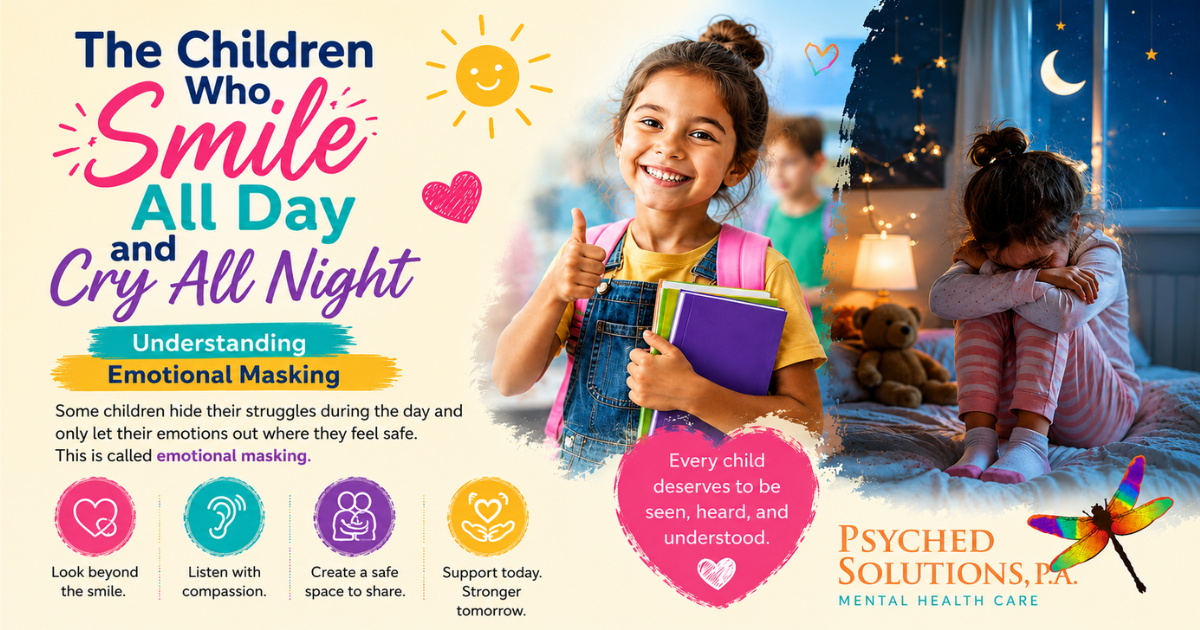
As a Licensed School Psychologist and Holistic Wellness Consultant with more than 25 years of experience, I have worked with many children who present a heartbreaking pattern. Teachers often describe them as "an angel," "a pleasure to have in class," or "one of my best students." Yet, when they return home, these same children may experience emotional meltdowns, withdraw from family, or cry uncontrollably.
To many parents, this contrast can feel confusing. If school says everything is fine, why is home so difficult?
In many cases, the answer lies in a phenomenon known as emotional masking.
What Is Emotional Masking?
Emotional masking is the process of hiding or suppressing natural emotions, behaviors, or sensory experiences in order to meet social expectations. For many neurodivergent children—particularly those with ADHD, Autism Spectrum Disorder (ASD), or other differences in neurodevelopment—masking becomes a daily survival strategy.
Throughout the school day, these children often work much harder than their peers to:
Follow complex social rules
Control emotional reactions
Manage sensory overload
Stay focused despite distractions
Appear calm and "typical"
While classmates and teachers may only see a well-behaved, successful student, the child may be investing an extraordinary amount of mental and emotional energy simply trying to fit in.
School becomes less about learning and more about maintaining a constant performance.
Why the Meltdowns Happen at Home
Many parents ask,
"Why does my child behave perfectly at school but fall apart at home?"
The answer is surprisingly reassuring.
Home is often the only place where a child feels emotionally safe enough to stop performing.
After spending an entire day regulating emotions, suppressing impulses, navigating social interactions, and managing stress, their emotional reserves become depleted. Once they arrive home, there is no energy left to continue masking.
This is what I often describe as the:
"Angel at School, Storm at Home" Paradox
The emotional release isn't manipulation or bad behavior.
It's exhaustion.
The Biology Behind Emotional Exhaustion
Emotional masking is not simply psychological—it is biological.
After prolonged stress, the brain's executive functioning system, primarily the prefrontal cortex, becomes fatigued. This area helps children with:
Emotional regulation
Decision making
Flexible thinking
Impulse control
Problem solving
As this system tires, the brain's emotional center—the amygdala—becomes more reactive.
The result?
A seemingly small request such as:
"Please clean your room."
"Let's start homework."
"Turn off the TV."
can suddenly trigger tears, anger, frustration, or an emotional meltdown.
For some children, especially those experiencing Rejection Sensitive Dysphoria (RSD), even gentle correction can feel intensely painful because their emotional regulation capacity has already been exhausted.
The Hidden Cost of Being "The Good Kid"
One of the greatest misconceptions I encounter is that excellent grades and good behavior always indicate emotional well-being.
Unfortunately, this is not always true.
Some children become experts at achieving while quietly sacrificing their mental health.
Every available ounce of energy is spent on:
Meeting expectations
Earning praise
Avoiding criticism
Maintaining self-control
Masking differences
Over time, there is little energy remaining for the experiences that truly nurture emotional health:
Rest
Play
Creativity
Family connection
Physical movement
Simply being themselves
Success without emotional wellness can leave children feeling empty, anxious, and chronically exhausted.
Moving from Correction to Connection
When we recognize emotional masking, our parenting approach naturally shifts.
Rather than asking,
"What's wrong with my child?"
we begin asking,
"What has my child been carrying all day?"
Children cannot be disciplined out of biological exhaustion.
Instead, they need support that strengthens their emotional capacity.
Helping Your Child Recover
Prioritize Rest
Quality sleep allows the brain to recover from the cognitive demands of the day. Restorative sleep supports emotional regulation, attention, learning, and resilience.
Create Recovery Time
Children need opportunities to decompress after school before transitioning into homework, extracurricular activities, or additional demands.
Quiet play, movement, creative activities, or simply spending time with family can help replenish emotional reserves.
Balance Achievement with Well-Being
Success should never come at the expense of emotional health.
Evaluate whether your child's schedule allows adequate time for rest, joy, and authentic self-expression—not just constant performance.
Seek Professional Evaluation When Needed
If your child consistently appears calm at school but struggles significantly at home, a comprehensive psychological evaluation can provide valuable insight.
Understanding how your child's brain is uniquely wired can replace frustration with clarity and transform the question from:
"What is wrong with my child?"
to
"How can we best support the way my child learns, feels, and experiences the world?"
Early identification and appropriate support can make a profound difference in both academic success and emotional well-being.
Every Child Deserves to Be Seen Beyond the Smile
Some children hide their struggles remarkably well.
They smile.
They achieve.
They follow every rule.
Yet behind that smile may be a child working tirelessly to navigate a world that feels overwhelming.
When we recognize emotional masking, we replace unrealistic expectations with compassion, judgment with understanding, and correction with meaningful connection.
Every child deserves the opportunity to thrive—not simply survive.
Is Your Child Struggling Behind a Mask of Success?
If your child appears successful at school but experiences emotional exhaustion or frequent meltdowns at home, a professional evaluation may provide the answers you've been searching for.
Dr. Angela C. Brinson, Ph.D. is a Licensed School Psychologist and Holistic Wellness Consultant serving families throughout Florida. She specializes in comprehensive evaluations for ADHD, Autism Spectrum Disorder (ASD), learning differences, and emotional wellness, helping families better understand their child's unique strengths and needs.
📞 Call: (954) 257-7473
📩 Contact us today to schedule a professional evaluation or holistic wellness consultation.
Please Note: Every child develops differently. A comprehensive evaluation helps us understand your child's individual strengths, challenges, and needs so we can provide personalized recommendations. No diagnosis or treatment recommendations are made without an appropriate evaluation.
Disclaimer
Disclaimer: This blog is provided for educational and informational purposes only and does not constitute medical, psychological, or mental health advice. Reading this article does not establish a psychologist-client relationship with Dr. Angela C. Brinson or Psyched Solutions, P.A. Every child is unique, and recommendations should be based on an individualized evaluation by a qualified professional. If your child is experiencing significant emotional or behavioral concerns, please consult a licensed healthcare or mental health provider.
