
Why Does My Child Understand Lessons but Get Poor Grades?
Why Does My Child Understand the Lesson but Get Poor Grades? Unpacking the Performance Gap
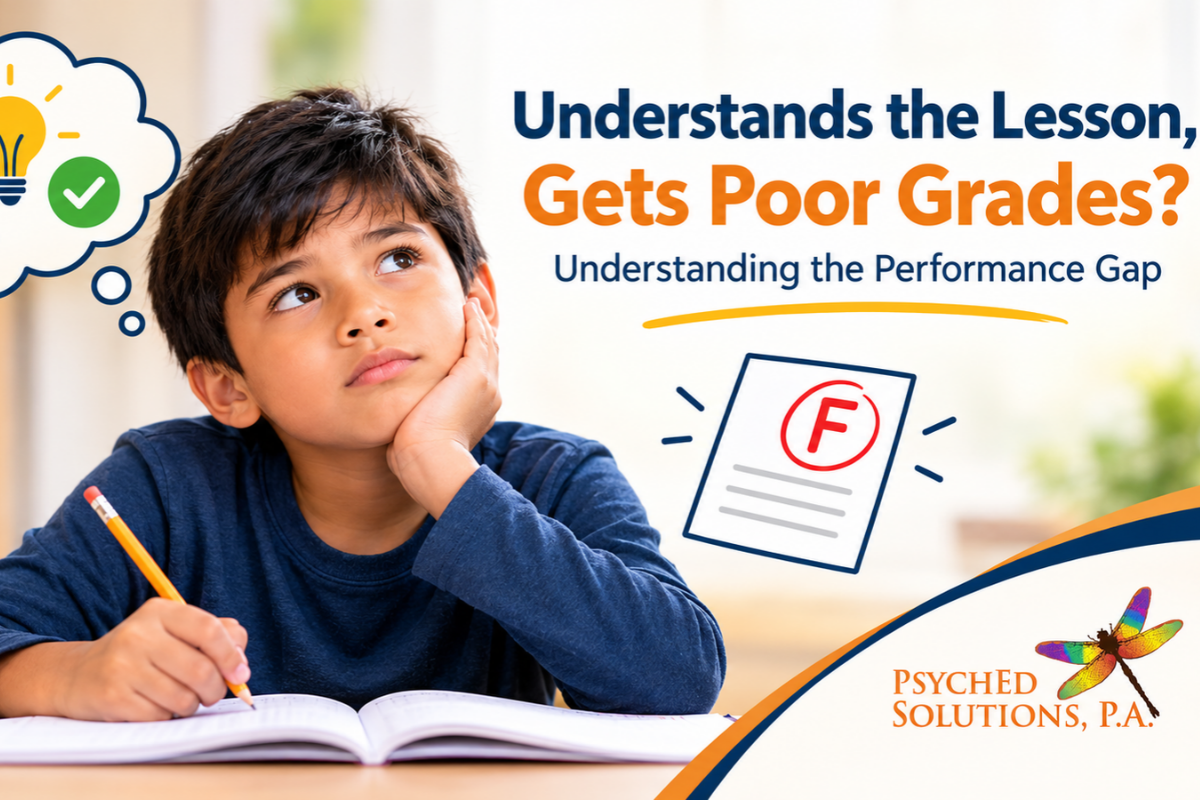
As a Licensed School Psychologist, one of the most painful frustrations I hear from parents in my Miami practice sounds like this: “Dr. Brinson, when I sit down with my daughter at night, she can explain the entire science chapter to me in detail. But when her report card comes home, her grades are filled with C’s, D’s, or missing assignments. How can she understand the material so well and still be failing?”
This discrepancy between intellectual understanding and academic output is what clinicians call the performance gap [115, 187]. It is heartbreaking for parents and deeply demoralizing for children [70, 188]. When a child clearly grasps the concepts but gets poor grades, adults often assume the child is being “lazy,” careless, or unmotivated [20, 203].
However, in school psychology, we know that grades reflect far more than raw intelligence [115, 159]. Getting good grades requires a complex series of cognitive, organizational, and emotional steps [159, 188]. When a bright child consistently underperforms, it is almost always due to an invisible bottleneck in how their brain executes tasks [20, 159].
Here are the four primary reasons why your child may fully understand their lessons yet continue to struggle on their report card—and how professional evaluation can help.
1. Executive Function Bottlenecks: The Output System is Blocked
Understanding a concept happens in the moment, but earning a grade requires executive functioning—the brain's internal management system used to filter, sequence, organize, plan, and manage tasks over time [159].
A student with executive function deficits (often associated with ADHD or neurodivergence) can easily absorb information during a classroom discussion [20, 159]. However, to turn that understanding into a grade, they must:
Notice and write down the assignment in a planner [154, 187].
Remember to bring the correct textbook or folder home [20, 154].
Initiate the task without getting paralyzed by distraction [188, 221].
Hold multiple steps in their working memory while solving problems [159, 188].
Physically organize the completed paper and remember to turn it into the teacher's bin the next day [154, 187].
If any single link in this executive chain breaks, the child receives a zero or a failing grade—even if they knew 100% of the answers [187, 188]. The issue isn't learning; it is task initiation, working memory, and organization [159, 221].
2. The Twice-Exceptional (2e) Paradox: "Easy is Hard, Hard is Easy"
If your child is intellectually gifted or possesses a high IQ alongside a learning difference or ADHD, they are considered Twice-Exceptional (2e) [116, 217].
For 2e children, cognitive development is asymmetrical [217]. Clinical experts describe this as the “easy is hard, and hard is easy” dynamic [217]:
Hard things are easy: They may naturally grasp complex mathematical equations, intricate creative theories, or advanced scientific concepts during lectures [217].
Easy things are hard: They may completely freeze, make careless errors, or experience severe task paralysis when asked to complete repetitive worksheets, follow rigid multi-step directions, or manage daily routines [217].
Because these students understand high-level concepts so effortlessly, teachers and parents often expect their daily schoolwork to be flawless [217]. When basic assignments are late, messy, or incomplete, the child is mislabeled as "not trying," when in reality, their executive system is severely overtaxed by low-stimulation, routine tasks [20, 217].
3. The "Wall of Awful" and Chronic Task Avoidance
When a child experiences repeated executive function breakdowns, they accumulate significant emotional baggage [70, 188]. After years of being told to "try harder" or receiving negative feedback for lost papers and careless mistakes, the child develops what clinicians call the "Wall of Awful"—a psychological barrier built from past failures, shame, and anxiety [70, 220].
When faced with a homework assignment or project, the fear of failing again triggers an escape-avoidance response [188, 210]. To protect themselves from emotional pain, the child procrastinates, shuts down, or avoids starting the work altogether [188, 221]. To an outside observer, this looks like defiance or a lack of caring [203, 221]. In truth, it is an overtaxed nervous system trying to protect itself from disappointment [70, 188].
4. Unrecognized Learning Disabilities or Processing Speed Differences
Sometimes a child's deep verbal understanding masks a specific processing difference that directly impacts written output or test performance [43, 199].
For example:
Processing Speed Bottlenecks: A student may know the material thoroughly, but if their brain requires more time to retrieve vocabulary or process written prompts, timed tests will result in poor scores [43, 210].
Co-Occurring Learning Disabilities: Up to 20% of students with ADHD also have a specific learning disability in math (dyscalculia) or reading (dyslexia) [199]. A child might verbally understand a story when read aloud, but struggle significantly when required to read and write responses independently [43, 199].
Developmental Visual-Spatial Differences: Difficulties with nonverbal processing can make formatting math problems on a page or organizing visual information an exhausting struggle, leading to lower test performance despite strong verbal skills [43, 45].
Moving from Willpower to Structural Scaffolds
If your child understands their lessons but receives poor grades, demanding more "willpower" or taking away privileges will not solve the underlying problem [20, 205]. You cannot punish a child into developing an executive function skill they currently lack [20].
Instead, true academic transformation happens when we shift from correction to connection and implement science-backed scaffolds [185, 217]:
Seek a Comprehensive Psychoeducational Evaluation: A professional evaluation identifies your child's exact cognitive strengths, working memory capacity, processing speed, and executive bottlenecks [62, 115]. It replaces guesswork with a clinical blueprint [54, 63].
Establish Formal School Accommodations: Through a Section 504 Plan or Individualized Education Program (IEP), students can receive targeted supports—such as extended test time, reduced homework volume, visual organizational checklists, or digital submission systems—that bypass output bottlenecks so their grades accurately reflect their true intelligence [10, 211, 213].
Implement External Systems: Replace abstract expectations with concrete visual tools, routine timers, and chunked assignment strategies [154, 187, 221].
Knowledge is a ray of hope [54]. When we understand how a child's brain is uniquely wired, we can give them the tools to bridge the gap between understanding and achievement—taking them from daily survival to true academic flourishing [54, 66, 148].
Is your child struggling with a gap between their intelligence and their grades?
📞 Call (954) 257-7473 👉 Message us to schedule a comprehensive psychoeducational evaluation or holistic consultation.
Dr. Angela C. Brinson, Ph.D., is a Licensed School Psychologist and Holistic Wellness Consultant based in Miami, FL, specializing in pediatric ADHD, Autism, Twice-Exceptional (2e) learners, and educational advocacy.
Disclaimer: The information contained in this blog post is for educational and informational purposes only and does not constitute medical or psychological recommendations, diagnosis, or treatment.
