Your Child Isn’t Lazy: Signs of Learning Difficulties | Florida
Your Child Isn’t Lazy—They May Be Struggling to Learn
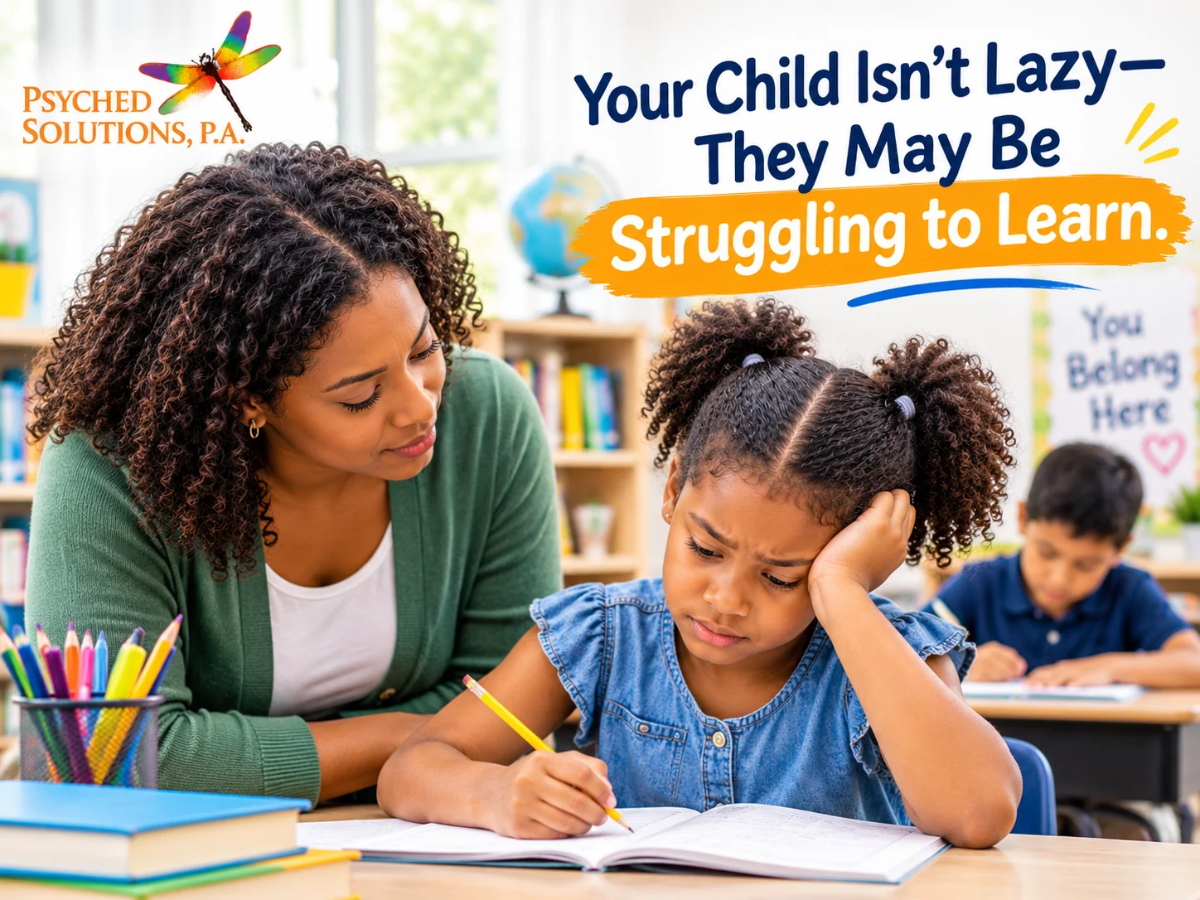
When a child repeatedly stares blankly at their homework, abandons assignments halfway through, or avoids sitting down at their desk altogether, adults often reach for a familiar label: “lazy.”
In our achievement-focused culture, productivity and follow-through are frequently treated as simple tests of character, discipline, and willpower. When an otherwise capable child resists schoolwork, it is easy to assume they are being defiant, unmotivated, or simply refusing to care.
As a Licensed School Psychologist with over 25 years of experience evaluating children and adolescents in Florida, I share a fundamental clinical principle with every family I meet:
Children do well if they can. When a child consistently struggles to meet everyday expectations, we are almost never looking at a moral failing or a lack of effort—we are looking at an invisible struggle with neurobiology and skill execution.
What looks like laziness on the outside is almost always an exhausting barrier on the inside. Understanding the real reasons behind academic avoidance is the first step toward transforming daily power struggles into meaningful, science-backed support.
1. Executive Dysfunction: A Stalled Cognitive Engine
Many children branded as lazy struggle with chemical bottlenecks in their executive functioning system—the brain’s internal management toolkit responsible for organizing information, planning multi-step actions, managing working memory, and initiating tasks.
For a neurodivergent brain, starting a task like writing an essay or cleaning out a backpack is not just a matter of "deciding to do it." Without adequate dopamine signaling in the brain's reward and motivation pathways, the cognitive sequence required to start simply stalls out. It is not that your child refuses to work; their brain is experiencing genuine task initiation paralysis. Calling this executive bottleneck "laziness" is like blaming a car for not moving when the ignition switch is disconnected.
2. The "Wall of Awful" and Protective Task Avoidance
When children struggle with learning differences, school is not just challenging—it can be emotionally painful. Every incomplete worksheet, corrective comment from a teacher, or frustrated sigh from a parent adds an emotional brick to what ADHD specialists call the "Wall of Awful."
This wall is built of accumulated shame, anxiety, and the fear of repeating past failures. When faced with an assignment where they have previously stumbled, a child's brain perceives an emotional threat.
In response, they resort to escape-avoidance behaviors—procrastinating, complaining, or shutting down completely. To an insecure student, being scolded for "not trying" feels far safer than trying their hardest, failing anyway, and believing they are fundamentally flawed. Avoidance is a shield, not apathy.
3. The Twice-Exceptional (2e) Paradox: “Easy is Hard, Hard is Easy”
If a child is intellectually gifted, adults are even quicker to mislabel them as unmotivated: “She is so brilliant—if she just applied herself, she would have straight A’s.”
This dynamic is the hallmark of the Twice-Exceptional (2e) learner—a child who possesses high cognitive abilities alongside a co-occurring learning or neurodevelopmental challenge, such as ADHD, dyslexia, or dyscalculia.
For 2e students, cognitive development is asynchronous:
They may effortlessly master complex conceptual discussions, advanced vocabulary, or creative problem-solving.
Yet, they may freeze or melt down over routine, low-stimulation tasks like rote memorization, handwriting, or turning in finished assignments.
Because their intellect is obvious, parents and teachers assume that basic organizational struggles are deliberate defiance. In reality, their advanced intellect and their executive or learning weaknesses exist side-by-side, creating intense internal friction.
4. Processing Speed and Working Memory Bottlenecks
A child’s speed of processing is an indicator of neurological pacing—not intelligence. Some children simply require more time to absorb instructions, retrieve stored facts, and organize their written or spoken responses.
In a fast-paced classroom or during timed tests, a student with slower processing speed quickly becomes cognitively flooded. When expected to keep up with rapid-fire directions, their working memory overflows, causing them to disengage or leave worksheets blank. To an observer, this withdrawal looks like disinterest or laziness, when it is actually cognitive overload.
5. Physiological Depletion: Cortisol and the Exhausted Brain
Cognitive stamina cannot be separated from physical biology. When a student spends their entire school day "masking"—straining to sit still, suppress natural impulses, and hide their academic challenges—their emotional reserve is completely drained by dismissal.
If the child also experiences disrupted or inadequate sleep, their body's primary stress hormone, cortisol, remains elevated. This keeps the amygdala (the brain’s emotional threat detector) on high alert while taking the rational prefrontal cortex offline. In this depleted neurological state, sitting down for an evening of homework is not just difficult; it feels physically and emotionally overwhelming.
Moving from Blame to Scaffolds: How Parents Can Help
Replacing the label of "lazy" with compassionate clinical curiosity opens the door to genuine progress. Here is how parents can shift from confrontation to collaboration:
Reframe the Conversation: Shift your question from “Why won't you just do this?” to “What part of this assignment feels overwhelming or stuck for your brain right now?”
Build External Scaffolds: Provide visual checklists, break multi-step projects into micro-tasks, use visual timers, and offer "body doubling" (sitting quietly nearby while they work) to support lagging initiation skills.
Address the Physiology: Prioritize consistent sleep hygiene, regular physical movement, and predictable downtime after school before transitioning to homework.
Secure Formal School Accommodations: An accurate clinical diagnosis allows families to establish legal protections such as a Section 504 Plan or an Individualized Education Program (IEP). Accommodations might include extended time, reduced homework volume, chunked assignments, or visual aids.
Explore Florida Educational Supports: For Florida residents, state-funded scholarship programs like Step Up For Students (such as the Family Empowerment Scholarship for Students with Unique Abilities, FES-UA) can provide vital funding for specialized tutoring, therapies, and tailored educational environments.
The Value of Professional Clarity
If your child is caught in an exhausting cycle of homework battles, tears, and self-doubt, guessing at the problem only prolongs the stress.
A formal psychoeducational evaluation acts as the missing piece of the puzzle. By thoroughly measuring cognitive abilities, academic skills, executive functions, and processing speed, an evaluation identifies your child's exact profile of strengths and vulnerabilities. It replaces painful labels with an actionable roadmap, empowering your child to step out of survival mode and begin truly flourishing.
Ready to Support Your Child’s Learning Journey?
At PsychEd Solutions, P.A., we help families replace academic frustration with scientific clarity and tailored solutions.
📞 Call (954) 257-7473
👉 Contact us today to schedule a comprehensive evaluation or educational consultation.
Dr. Angela C. Brinson, Ph.D., is a Licensed School Psychologist and Holistic Wellness Consultant based in Miami, FL, specializing in pediatric ADHD, Autism, Twice-Exceptional (2e) learners, learning disabilities, and school advocacy.
