
Everyone Thought He Was “Difficult”: ADHD Signs Florida Parents Often Miss
“Everyone Thought He Was Just ‘Difficult’”: The ADHD Signs Florida Parents Often Miss
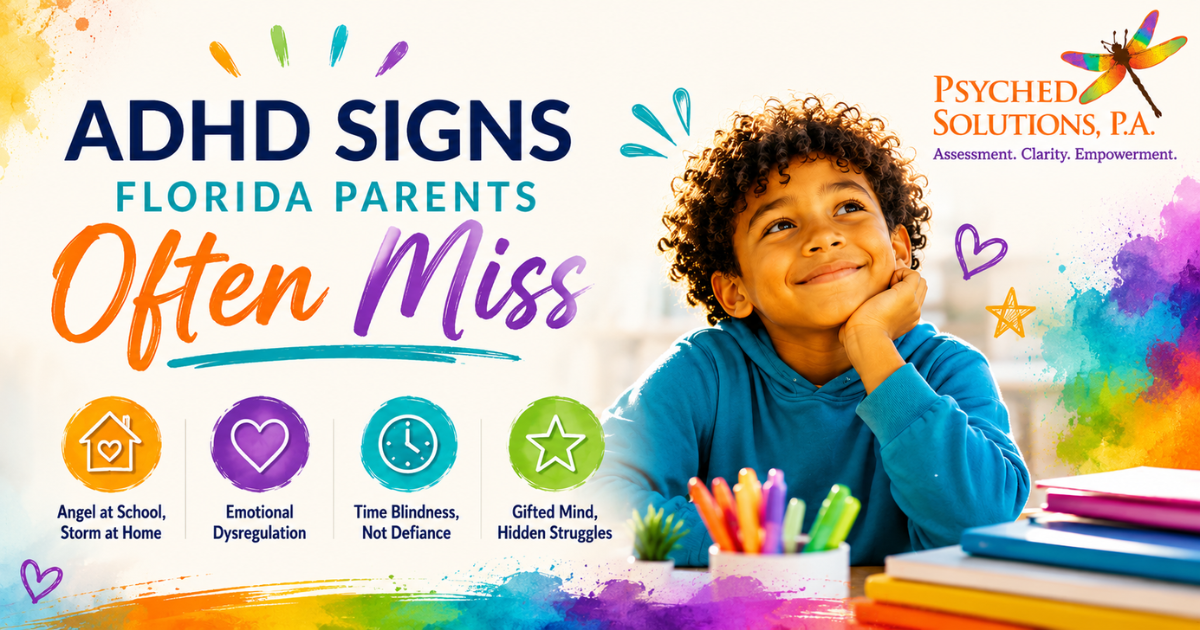
For many Florida families, the journey toward an ADHD diagnosis does not begin in a doctor’s office—it begins with a label.
“He’s lazy.”
“She’s too emotional.”
“They just need more discipline.”
“He’s brilliant, but so difficult.”
After more than 25 years as a Licensed School Psychologist, I have seen how often children with ADHD are misunderstood long before they are properly supported. What appears to be defiance, carelessness, or attitude is frequently a neurological difference in how the brain manages attention, emotions, organization, and self-control.
When these signs are missed, children often grow up believing something is “wrong” with them. Many begin to internalize shame, frustration, and failure—despite trying harder than anyone realizes.
Behind many “difficult” children is a child who is exhausted from struggling to meet expectations they cannot yet manage alone.
1. The “Perfect at School, Explosive at Home” Pattern
One of the most overlooked ADHD signs is the child who appears calm, respectful, and cooperative at school—but falls apart emotionally at home.
Parents are often confused:
“How can my child behave so well for teachers but melt down with me?”
The answer is often masking.
Many children with ADHD spend the entire school day forcing themselves to stay focused, suppress impulses, follow social expectations, and avoid getting into trouble. This constant self-monitoring is mentally exhausting.
By the time they get home—the place where they finally feel emotionally safe—their nervous system is depleted. What looks like anger, disrespect, or overreacting is often emotional burnout.
These children are not “saving their worst behavior” for parents. They are running out of emotional energy.
2. Emotional Outbursts Are Often Neurological, Not Behavioral
ADHD is not only about attention. For many children, the greatest challenge is emotional regulation.
A small correction may feel devastating.
A simple reminder can trigger tears, yelling, or complete shutdown.
Many children with ADHD experience intense emotional sensitivity, sometimes referred to as Rejection Sensitive Dysphoria (RSD). Even minor criticism or redirection can feel deeply painful to them.
Parents often say:
“They overreact to everything.”
But these reactions are not usually intentional manipulation or dramatic behavior. The ADHD brain processes frustration and emotional stress differently.
A child who explodes after being told to clean their room may not be choosing defiance—they may be experiencing genuine neurological overwhelm.
3. “Time Blindness” Is Frequently Mistaken for Laziness
Does your child ignore repeated reminders until the very last minute?
Do mornings become constant battles filled with rushing, frustration, and yelling?
Many parents assume their child simply “doesn’t care.” In reality, children with ADHD often struggle with time blindness—a difficulty sensing time, planning ahead, and mentally organizing future tasks.
For these children, deadlines often do not feel real until urgency becomes extreme.
What looks like irresponsibility is often an executive functioning difficulty—not a lack of intelligence or effort.
4. The Gifted Child Who Is Secretly Struggling
Some of the most overlooked children are highly intelligent students.
Because they perform well academically in early grades, their ADHD symptoms are often dismissed or missed entirely. Their intelligence masks the struggle.
This is known as Twice-Exceptionality (2e)—when a child is both gifted and neurodivergent.
These children may:
Read far above grade level
Ask highly advanced questions
Solve complex problems creatively
…while simultaneously:
Forgetting assignments
Losing materials constantly
Struggling with routines
Appearing disorganized or careless
Parents and teachers often say:
“They’re too smart to be struggling like this.”
But intelligence does not eliminate ADHD. It simply hides it longer.
The Emotional Cost of Being Misunderstood
When ADHD goes unrecognized, children often receive repeated negative messages:
“Try harder.”
“Stop being lazy.”
“You’re not applying yourself.”
“Why can’t you just listen?”
Over time, these children may begin to believe they are failures—even when they are working twice as hard as their peers just to keep up.
Many eventually develop anxiety, low self-esteem, school avoidance, or emotional shutdown because they spend years feeling misunderstood.
The earlier we identify the real issue, the sooner we can replace shame with support.
Moving From Labels to Clarity
A professional evaluation does more than provide a diagnosis—it provides understanding.
When we understand how a child’s brain works, we can stop focusing on punishment and begin building effective support systems, emotional safety, and practical strategies that help children succeed.
In my practice, I use a dual-lens approach that combines comprehensive psychological assessment with holistic wellness support. We examine not only attention and learning, but also sleep quality, emotional regulation, stress, nutrition, and environmental factors that affect a child’s ability to function successfully.
Because without proper support, even the brightest child can struggle.
And with understanding, structure, and compassion, even the most misunderstood child can thrive.
Ready to Move From Confusion to Clarity?
📞 Call: (954) 257-7473
📩 Message us to schedule an evaluation or learn more about Step Up For Students support.
